AI4NextG @ ICML'26
Workshop on AI and ML for Next-Generation Wireless Communications and Networking
An Academia-Industry Collaboration Perspective
ASEM Ballroom 203, Seoul, South Korea — Friday, July 10, 2026

ASEM Ballroom 203, Seoul, South Korea — Friday, July 10, 2026
The field of wireless communications and networking is undergoing a paradigm shift, driven by the growing potential of Artificial Intelligence (AI) and Machine Learning (ML) to redefine traditional system design principles. This workshop aims to catalyze interest and foster collaboration between the AI/ML and wireless communications communities. The timing of this workshop is especially significant, as the next-generation (NextG) wireless standardization efforts (such as 6G and WiFi 9) are just getting started, with AI-native technologies expected to play a central role across all aspects of the wireless ecosystem – from radio access to network management and edge intelligence. NextG represents a foundational shift in global infrastructure, enabling ultra-fast, low-latency, and intelligent connectivity that will power future applications in AI, robotics, immersive environments, and autonomous systems. These technologies offer unprecedented opportunities to both drive and benefit many applications, from healthcare and transportation to industrial automation and environmental monitoring. The economic and societal implications are vast: NextG networks will underlie trillions in global GDP impact, bridge digital divides, and shape how billions of people interact with technology and each other in the decades to come.
Despite the clear promise, a significant disconnect exists between the AI/ML and wireless research communities. AI/ML experts often lack an understanding of the unique physical, algorithmic, and architectural constraints inherent in wireless systems, while wireless researchers tend to adopt generic, off-the-shelf AI/ML models that are not optimized for the intricacies of wireless environments. To date, workshops and conferences exploring this intersection have predominantly emerged within the wireless community itself (e.g., in IEEE ComSoc), with very limited participation from the AI/ML research community. As a result, there is a pressing need to expose the AI/ML community to these domain-specific challenges, which are not only intellectually stimulating but also call for new theoretical frameworks and algorithmic innovations that have the potential to drive forward progress in AI/ML itself. This is precisely why we host AI4NextG at a premier ML venue such as ICML, where AI/ML researchers will naturally be present.
This Second Workshop aims to bring together researchers and practitioners from both academia and industry at the intersection of AI/ML and wireless, with a specific focus on fostering deep, sustained collaboration to accelerate deployable AI solutions for NextG wireless. Without a deliberate effort, AI/ML for wireless risks diverging into parallel tracks of elegant theory and pragmatic engineering that rarely converge in real deployments. We seek to bridge this gap by engaging discussions across the full protocol stack, with a focus on AI-native designs for 6G and beyond.
Building on the success of our inaugural edition at NeurIPS 2025, which brought together over 61 accepted papers and 11 invited talks from leading academics and industry researchers, we are excited to continue this series at ICML 2026.
The workshop will cover a broad range of topics that highlight both foundational research and practical applications of AI/ML in wireless systems. Key themes include, but are not limited to:
We welcome contributions that push the boundaries at this unique intersection and aim to create an engaging forum for students, scholars, and practitioners worldwide to share insights, discuss progress, and chart future directions in this exciting field. We invite technical papers with up to 6 pages each, vision/position papers with up to 4 pages each, and demo papers with up to 2 pages each (excluding references and appendices), reviewed by our workshop program committee. All submissions must use the official ICML 2026 LaTeX style file. All double-anonymous submissions should not contain author names or identifying information.
The submission portal will open on April 10, 2026, and the deadline is May 4, 2026 (AoE). The review process will be facilitated via OpenReview. Please make sure every author has an OpenReview account ahead of submission. The submission portal can be found here.
Accepted papers will be accessible via this website ahead of the workshop. Our workshop is non-archival and there are no formal proceedings. We allow submissions of manuscripts that have not been accepted by an archival conference, i.e., if your paper is in submission with an archival conference/journal at the time of the workshop submission deadline you are welcome to submit to AI4NextG.
[Please be aware] OpenReview's moderation policy for newly created profiles: New profiles created without an institutional email will go through a moderation process that can take up to two weeks. New profiles created with an institutional email will be activated automatically.







We are pleased to announce the Best Paper and Runner-up awards for AI4NextG @ ICML'26. The awards were presented by Qualcomm representative Taesang Yoo.
MambaCSP: Hybrid-Attention State Space Models for Hardware-Efficient Channel State Prediction
Aladin Djuhera, Haris Gacanin, Holger Boche
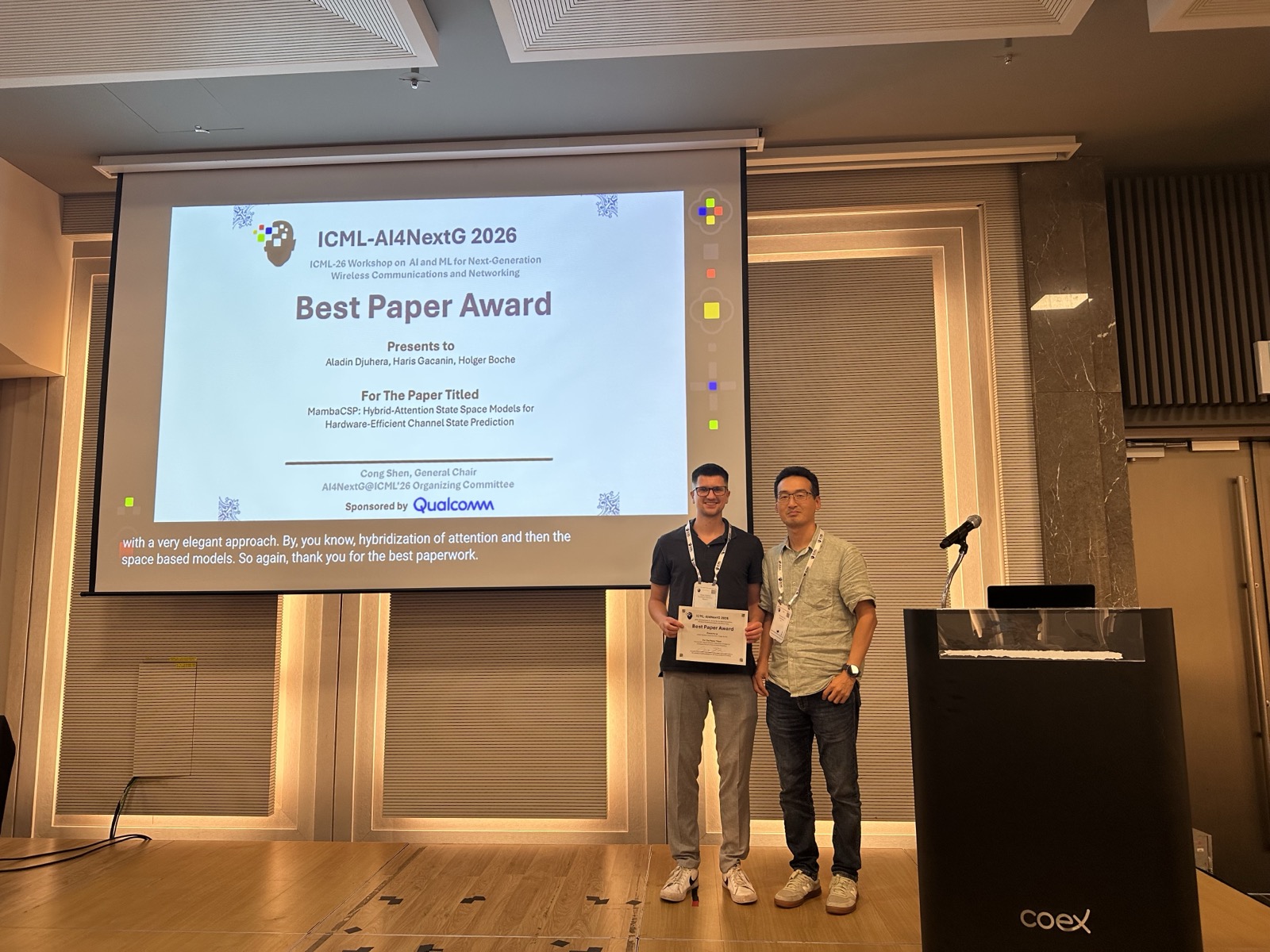
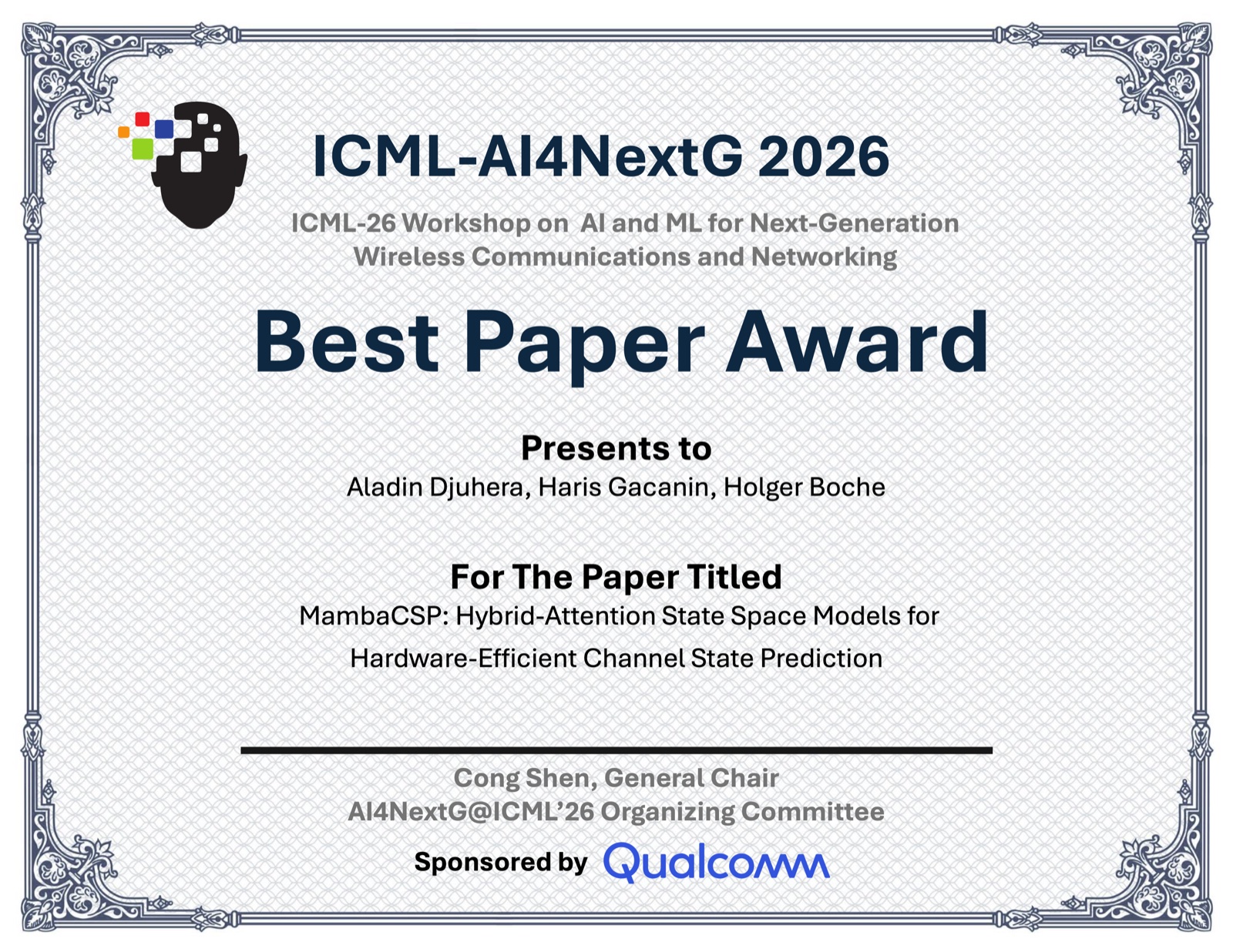 Certificate — click to enlarge
Video Generation Empowered Long-Term Radio Map Prediction in UAV-Assisted Communication
Lin Zhu, Weifeng Zhu, Shuowen Zhang, Liang Liu
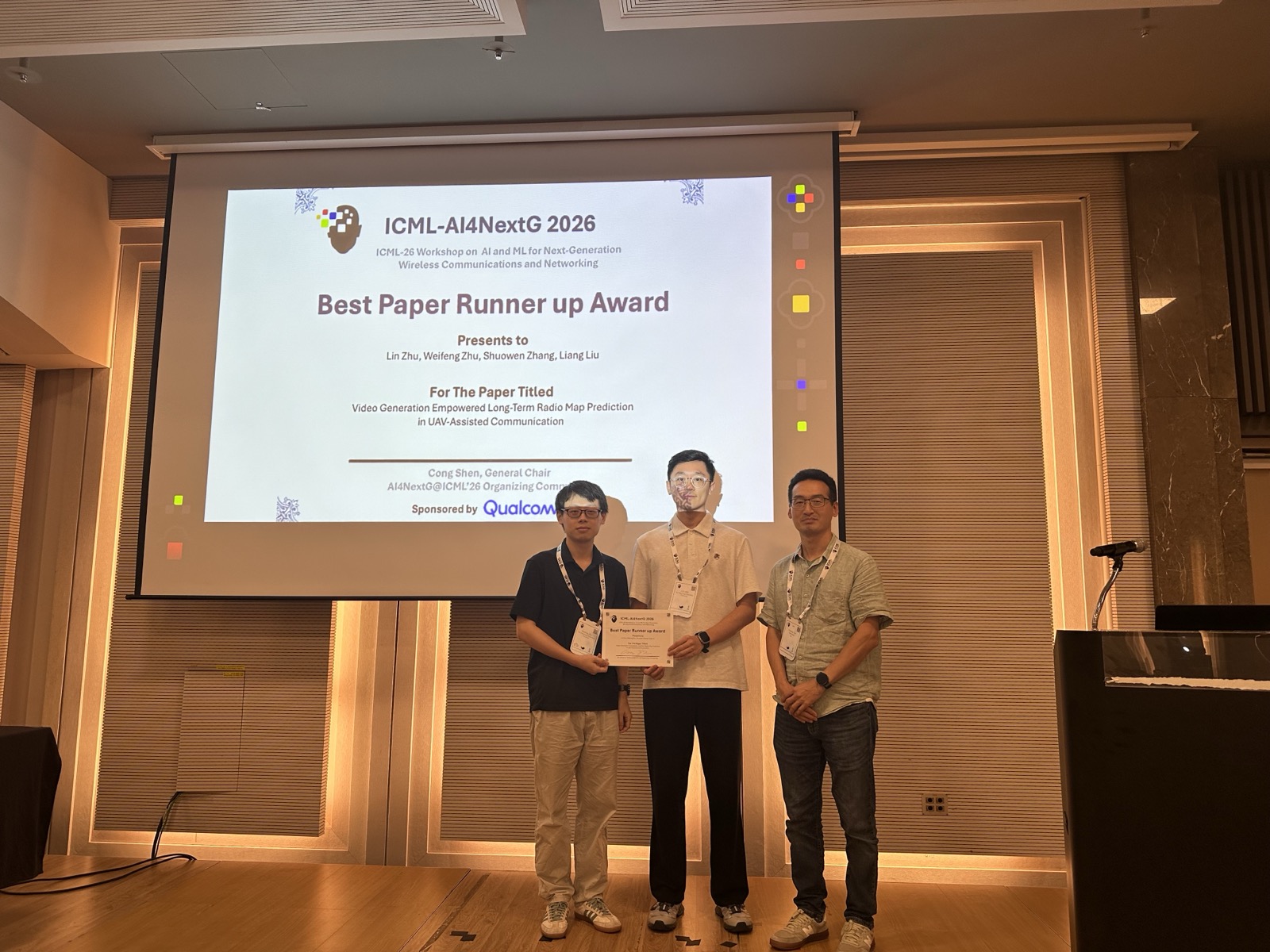
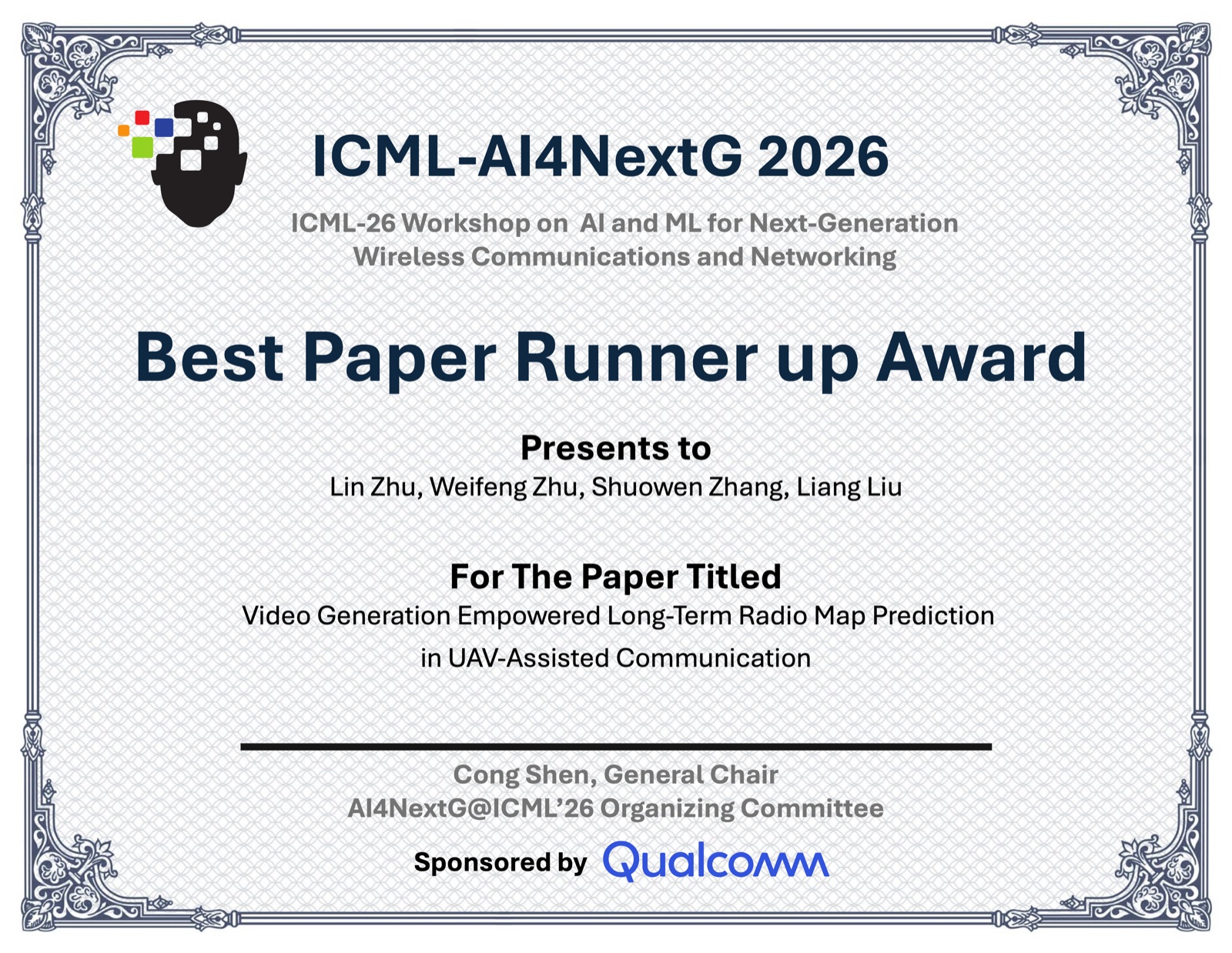 Certificate — click to enlarge
We gratefully acknowledge Qualcomm's generous support in sponsoring these awards.
The workshop will be held from 8:00 a.m. to 5:00 p.m. on Friday, July 10, 2026 at ASEM Ballroom 203, ICML 2026 main conference center, Seoul, South Korea. All times in the schedule are in KST (Seoul local time). The detailed program is subject to minor adjustments.
| Time | Session | Speaker |
|---|---|---|
| 8:00am to 8:15am | Opening Remarks | |
| 8:15am to 8:45am | Keynote 1: Integrating Intelligence into Wireless Systems: Learning for Spectrum Awareness, Spatial Prediction, and Robustness to Hardware Impairments | Danijela Cabric |
| 8:45am to 9:15am | Keynote 2: Wireless Research at the Speed of Inference | Sebastian Cammerer |
| 9:15am to 10:00am | Coffee/Snack Break | |
| 10:00am to 10:30am | Keynote 3: TBD | Chris Brinton |
| 10:30am to 11:00am | Oral Session 1 | Papers #1-3 |
| 11:00am to 11:30am | Keynote 4: Co-Designing AI and Wireless: Toward Intelligent 6G System | Min Jang |
| 11:30am to 12:00pm | Keynote 5: TBD | Bob Friday |
| 12:00pm to 1:00pm | Lunch | |
| 1:00pm to 2:00pm | Poster Session (Row 2300–2313 in Hall A) | |
| 2:30pm to 3:00pm | Keynote 6: TBD | Taesang Yoo |
| 3:00pm to 3:30pm | Coffee/Snack Break | |
| 3:30pm to 4:00pm | Oral Session 2 | Papers #4-6 |
| 4:00pm to 4:30pm | Keynote 7: Hybrid AI for Radio: When Models Must Understand, Not Just Fit | Zsófia Kallus |
| 4:30pm to 5:00pm | Awards Announcement, Closing Remarks |
All accepted papers can be accessed through the OpenReview portal for the ICML 2026 Workshop AI4NextG.
Poster session. The poster session will take place in Hall A. Our workshop has been assigned Rows 2300–2313, and both sides of each row may be used. There will be only one poster session, so authors may leave their posters displayed in these rows for the full day.
Poster size. The required workshop poster size is portrait format, 36 inches high by 24 inches wide (91 cm high by 61 cm wide). Please note that this differs from the poster size used for the main conference.
Camera-ready. The camera-ready deadline is July 31, 2026, AoE, which is after the workshop. We encourage you to update your paper based on any additional feedback you receive during the workshop discussions.
| # | Title | Authors | Decision |
|---|---|---|---|
| 1 | MambaCSP: Hybrid-Attention State Space Models for Hardware-Efficient Channel State Prediction | Aladin Djuhera, Haris Gacanin, Holger Boche | Oral |
| 2 | Video Generation Empowered Long-Term Radio Map Prediction in UAV-Assisted Communication | Lin Zhu, Weifeng Zhu, Shuowen Zhang, Liang Liu | Oral |
| 3 | Sample-Efficient Self-Interference Cancellation for In-Band Full Duplex Radios via In-Context Learning | Rushabha Balaji, Abhiram Kadiyala, Danijela Cabric, Suhas Diggavi | Oral |
| 4 | Intent-Driven 6G Service Orchestration: Grounded Translation, Validation, and Decomposition | Jean Martins, Leonid Mokrushin, Marin Orlic, Amardeep Kumar A | Oral |
| 5 | A Tale of Two Learning Algorithms: Multiple Stream Random Walk and Asynchronous Gossip | Peyman Gholami, Hulya Seferoglu | Oral |
| 6 | Graph-Localized Offline Federated Multi-Agent Reinforcement Learning for Wireless Networks | O. Tansel Baydas, Ayse Sila Okcu, Ozgur B. Akan | Oral |
| 7 | Certified Characterization of Privacy, Participation, and Convergence in Over-the-Air Federated Learning | Ayse Sila Okcu, O. Tansel Baydas, Ozgur B. Akan | Poster |
| 8 | Towards Edge-deployable Telecom Intelligence with Efficient Small Language Models | Somin Im, Heewon Park, Minhae Kwon | Poster |
| 9 | Against the Monolithic Wireless World Model: Why NextG Needs Composable and Agentic Intelligence | Aladin Djuhera, Farhan Ahmed, Vlad C. Andrei, Swanand Ravindra Kadhe, Alecio Binotto, Haris Gacanin, Holger Boche | Poster |
| 10 | Risk-Calibrated Semantic Transmission for Communication-Efficient Heterogeneous Collaborative Inference | Byeonghyeon Park, Joonhyuk Kang | Poster |
| 11 | Domain Adaptation Under Wireless Network Constraints: When Does It Become Green? | Illyyne Saffar, Aurelie Boisbunon, Shruti Bothe | Poster |
| 12 | Structured Masked Diffusion for Joint Multiuser Decoding | Taekyun Lee, Jiyoung Yun, Jeffrey Andrews, Hyeji Kim | Poster |
| 13 | Learning to Offload with Low Regret under Asymmetric Misclassification Costs | Umang Agarwal, Vinay Sutar, Sharayu Moharir | Poster |
| 14 | Interpretable and Privacy-Preserving Federated Learning via Subspace Representations | Jaein Lee, Jungwoo Lee | Poster |
| 15 | Beyond Exact-Match: Semantic Authentication for AI-Native Wireless Systems | Sang Wu Kim, Anders Host-Madsen | Poster |
| 16 | Capacity-Aware Federated Offline Reinforcement Learning for Resource-Heterogeneous Edge Clients | Seungchan Yu, Kyungjae Lee, Jungchan Cho, Jungwoo Lee | Poster |
| 17 | PilotWiMAE: Wireless Channel Pilots Are All You Need | Berkay Guler, Giovanni Geraci, Hamid Jafarkhani | Poster |
| 18 | Value Decomposition Fails in Anti-Coordination: A Systematic MARL Comparison for Dynamic Spectrum Access in Dense 6G Networks | Aayam Bansal, Raghav Agarwal, Ishaan Gangwani | Poster |
| 19 | Inductive Latent Context Persistence: Closing the Post-Handover Cold Start in 6G Radio Access Networks | Anubhab Banerjee, Daniyal Amir Awan | Poster |
| 20 | Normalization-Free Knowledge Distillation for Variable-Bit CSI Feedback in Massive MIMO | Eunju Seo, WooJun Kim, Dongjin Ji | Poster |
| 21 | Toward Reliable Intrusion Monitoring for O-RAN Based Networks with Conformal False Alarm Control | Joohong Rheey, Hyunggon Park | Poster |
| 22 | Deep Reinforcement Learning-based Multi-Target Tracking and Association in Cooperative Millimeter-Wave ISAC Systems | Tongkai LI, Weifeng Zhu, Shuowen Zhang, Jiannong Cao, Shuguang Cui, Liang Liu | Poster |
| 23 | PAW: Parallel-Wavelet Attention for Lightweight Asymmetric Semantic Image Communication in 6G Space Networks | Ziyang MENG, Yuheng Zhang, Lu Lu, Jianhua He, Yongsheng Gong | Poster |
| 24 | Efficient Graph Attention-based Learning for Traffic Prediction and Uncertainty-Aware Anomaly Detection in AI-driven O-RAN | Tzu-Herng Wang, Lan-Huong Nguyen, Ren-Hung Hwang, Van-Linh Nguyen | Poster |
| 25 | Self-Explaining Reinforcement Learning for Mobile Network Resource Allocation | Konrad Nowosadko, Franco Ruggeri, Ahmad Terra | Poster |
| 26 | Beyond Type-II: Site-Specific Subspace Inference for Efficient CSI Feedback | Cheng-Jie Zhao, Zhaolin Wang, Zongyao Zhao, Yuanwei Liu | Poster |
| 27 | Distribution-Free Adaptive Modulation and Coding via Online Conformal Inference under Non-Stationary Fading | Soham Batra, Siddharth Karuturi, Kaustubh S. Bukkapatnam, Laksh Patel, Tanush Ajay Shastry, Matthew Park | Poster |
| 28 | Conformal Semantic Communication: Distribution-Free Task-Level Coverage Guarantees for Goal-Oriented Transmission Under Channel Shift | Soham Batra, Siddharth Karuturi, Kaustubh S. Bukkapatnam, Laksh Patel, Tanush Ajay Shastry, Matthew Park | Poster |